Saturday, August 28, 2010

Searching for Regency London


Fenton House, Hampstead, Continued
by Michele Ann Young

How about that for a garden and a view from a window. So green and well organized. The weeds in my garden won the battle this year.

This is just a small sample of the lovely views. I took more but thought this was probably enough to "get the idea". I might add another one at the end.


So leaving the ground (first) floor we go up stairs. Here you can see down from the top and get a better sense of the twisted balusters and the large window.

On this floor there are four rooms set around a square landing. The servant's stairs also emerge on this landing, making the two north facing rooms quite small.


This bedroom is the largest. It once had a closet, now an alcove beside the fireplace for powdering ones wig (rather than one's nose).

The columns were thought to be added in 1810 replacing a wall which created the narrow access passage to the clock in the centre east front wall. Where the plates are was originally another concealed or jib door to the adjacent bedroom. The instrument shown in the alcove is a spinet.


This next room is a drawing room, and apparently was always a drawing room. So this house only had three bedrooms on this second floor. The decoration of this room, the dentil frieze and the arched alcoves are likely early nineteenth century.


We still have two more rooms on this floor, but the photos take forever to load and the sunny day is calling me outside. So until next time, Happy Rambles.

Tuesday, August 24, 2010

Searching for Regency London

By Michele Ann Young


Fenton House continued


We saw the narrow servants' stairs in the previous set of pictures. Here are the stairs the family would have used.  Not the impressive staircase of some of the houses we have seen, but clearly wide, with lighting from a large window on the first landing, which itself is wide enough for a chair. The window looks out over the walled garden.

This is the original seventeenth century staircase with twisted balusters. Now we go upstairs


This next room on the ground floor has been described as a small sitting room, or study and displays some of the finest figurines from England and the continent in the eighteenth century. Some of the English makers are Bristol, Bow, Chelsea and Derby.

The mirror between the windows is fine gilt gessor, or sconce, once equipped with branches for candles from 1715. The instrument is a 1612 harpsicord.

This is the last room on the ground floor, and its use in our time is not described. The alcove off to the right would have been a closet, not open as it is now.

It now displays early Chinese ceramics some of which were imported into England in the late seventeenth and early eighteenth centuries.

Next time we will climb the staircase and look around upstairs. Until then Happy Rambles.

Tuesday, August 17, 2010

Searching for Regency London

by Ann Lethbridge


One of my most interesting visits this summer was to Fenton House in Hampstead.

Pictured first is the South Front, which faces down Holly Hill (a particularly steep hill I might add)

In the regency period, Hampstead was a small city separate from London and a place where the middle class professionals lived, rather than the fashionable, though the Heath itself drew many visitors. The village and the heath sits high on a hill overlooking London and at one time could be seen as wooded hills behind the city from the other side of the river.

Fenton House has remained remarkably untouched since it was built in 1756, being a substantial brick house with extensive gardens of fruit trees and kitchen gardens enclosed in a brick wall.

Today much of the house is given over to collections of pictures and musical instruments which are interesting. My main interest however was with the house itself. The way it would have been lived in.

Various parts of the house has been altered over the years, but still it retains much of its original structure.

The entrance hall shown here, with the service stairs behind which can be shut off by a door is a far more modest area that we see in the grand houses we have visited. The frieze around the ceiling dates from about 1810.

The long case clock you can see dates from 1700.


Here is a closer look at the frieze:


Moving into the dining room we can see that it was once divided into two rooms, a dining room and a drawing room.


The chairs at the table are 18th century mahogany. The harpsicord off in what was a drawing room is a Shudi and Broadwood from 1770. One of the earliest with the Broadwood name.


These lyre back chair are Regency and there is also a winecooler in the shape of a classical sarcophagus tucked under the sideboard which is also Regency.


The alcove, part of what was the drawing room which clearly goes into one of the protrusions you can see on the outside of the house contains one of the very popular Broadwood Square pianos, this one from 1774


Sadly this is all we have time for today. But lots more next time. Until then, happy rambles.

Sunday, August 15, 2010

by Michele Ann Young

I'm late. I'm late.......


Glow Worms

There was a bit of a discussion about the presence of glow worms in Britain on one of my lists, and when browsing the Naturist for 1815 this is what he had to say for August:


... compensated by the presence of the lady-bird and the glow-worm; the first for its utility and the second for the beautiful effect it produces.


A bit of research on glow worms in the uk reveals that British glow worms are different from North American fire flies. They are females trying to attract a male, they do not fly during this lighting up phase and always have been rather rare, and only live about two weeks.

However one can imagine a romantic evening in August and the sight of some glow worms adding to the charm of the scene. As an aside, during a walk last July in Washington DC at dusk I was enchanted by the hundreds of fireflies hovering just above the grass, it was like being in fairyland.

Ladybirds

Ladybird ladybird fly away home,
Your house is on fire and your children are gone
All except one and that's little Ann
And she crept under the frying pan

I can remember singing this to ladybirds, and blowing on them to make them fly away. There are several ideas about the origins. One is: In Medieval England farmers would set torches to the old hop (used in flavoring beer) vines after the harvest in order to clear the fields for the next planting. This poem was sung as a warning to the ladybugs that were still crawling on the vines in search of aphids.

The reason our naturist thinks they are useful is that they feed on aphids, scale insects, mealybugs, and mites throughout the winter .

Until next time, Happy Rambles

What I am reading:
Dangerous Desires by Dee Davis

Tuesday, August 10, 2010

Regency Fashion for August


by Ann Lethbridge
A fun reminder that the Anthology New Voices
is out this month. You won't see this kind of cover on my blog very often, so I hope you enjoy. My story is called The Governess and the Earl. I do hope you will check it out.

While this book is out in print in the UK you can find it in all the usual on line places in North America too. Here is the link for the UK
New Voices

Now to the important stuff.


From the Ladies Magazine for August 1810

A morning dress of white Indian muslin with high front and collar, edged with lace, and confined with silk buttons from the throat to the feet. A yellow silk pelisse trimmed with broad white lace, and lined with pink sarscenet. Woodland straw bonnet, with yellow and pink feather. A cottage cap of lace, ornamented with an artificial white rose. Pink sandal shoes; with yellow kid gloves.


The Evening Dress is described as a white frock of French cambric, with short plain sleeves. A long scarf of light blue silk; a turban composed of the same, and white satin. Jewels, sapphire, and gold. Gloves and shoes of white kid.

The scarf is indeed long.


This one is from the Ladies Magazine for 1800.

While we do not have a description of this plate as we do of some others here are some of the remarks relevant to this costume.

Nothing is now so elegant as a straw hat of open work, thick- set with points of plaited straw


The medallions, called breviaries, and the chains from their crossing called saltiers, are much worn:


In plain silks, jonquil is the prevailing colour.

And that is all we have for now. Until next time, Happy Rambles.

Friday, July 30, 2010

RWA News

Cool news! My novel, The Rake's Inherited Courtesan won one of the prestigious Daphne's here at the RWA conference in Orlando.


Here you see me with two other nominees from Harlequin Historicals, Julia Justiss and my chapter mate Kate Bridges, and the two harlequin editors, Joanne Grant and Linda Fildew. Needless to say we were all very happy.

Thank you Kiss of Death!

What an exciting evening.

Thursday, July 22, 2010

Searching for Regency London

by Michele Ann Young

Another week gone already? Oh no. I want summer to last forever.

After Horse Guards I wandered back to my hotel. Refreshed, the next day I had one very particular spot on my mind. St. George's, Hanover Square, because Ann had just written a wedding scene there for "The Gamekeeper's Lady", due out in Hardcover in December. Anyway, my luck wasn't in. The Church is closed for renovations. They need lots of donations and I am providing you with a link to the official site. http://www.stgeorgeshanoversquare.org/ Dame Judi Dench is their Patron. However, I did take some pictures, as we were interested in the steps and the access.

One thing you need to know, the Church is not in Hanover Square, but on St George's Street to the south of the square.  You will see this quite clearly on Google if you wish, and probably in the A to Z of Regency London.


Here you can see along the street, with Hanover Square behind on the left.  There are several very nice Georgian buildings remaining in this street.On the right is a picture taken looking up towards the square, where the trees are. Again, more Georgian buildings.


These are views of buildings from the steps.  I thought it particularly interesting that one of the shops, the one with the bow front was a bespoke taylors which now incorporates Hicks and Sons, established in 1797.  Hicks and sons would have been most likely located in Saville Row, but the building they occupy now might well have been around at the time.

And below are the steps up which the hero's brother dashed just in time!


Since I had walked to Hanover Square, in search of my church, we ought to pay it a visit too.

Hanover Square was the first square built in London. Started in 1717, it was originally surrounded by fields. This picture shows it around 1754 looking north.

Included in the surrounding buildings in our time were the Hanover Square rooms built in 1774-75 in place of the original Number 4. They were built by the Swiss-Italian dancing master to the royal family, Sir John Gallini. Bach was a shareholder in the rooms and gave concerts there from 1775-1782, as did Hayden between 1791 to 1794.  The musical connection continued well past the Regency until 1874.

Number 21 was occupied by the French Ambassador, Prince Tallyrand, but after our period.

Today, there are a great many more trees, a whole lot more traffic of a very different sort, and it is fenced in with iron railings.

That is all I have time for tonight, I hope you enjoyed this visit. Lots more to come, until then, Happy Rambles.

What I am reading right now.
The Girl with the Dragon Tattoo

Monday, July 19, 2010

Searching for Regency London

by Ann Lethbridge


Horse Guards.

When I visited they were preparing for the trooping of the color, and there were bleachers up against the walls, so I am using this picture from Wikipedia for the wide angle shot.

The present day building was finished in 1753 and was built on the site of the stable yard for the old Whitehall palace. The Duke of Wellington was based here when he was commander in chief of the British Army.


Here we see the clock with the royal arms of George II beneath.


And this is the chick sentry, so called because a soldier called to account for being asleep on duty indicated he was supposed to be guarding the sergeant's chickens when in fact he is guarding the stables. At the time of the Regency there was stabling for 62 horses.

The basement also included a cockfighting pit and a raised viewing area. Something to keep those "Hyde Park soldiers" entertained.


The sentries, mounted and dismounted, still guard the Whitehall side of Horseguards.

As an army brat, I tend not to bug soldiers at their duty and so only took this one picture from a distance of the mounted sentries, but you can find them all over the web.

I was glad to have this opportunity to wander around Horse Guards, since two as yet published books have scenes set in this location and being there really helps make the scenes authentic. I took a great many more pictures for myself, but these give the flavor of what existed during the regency.

We will be searching for more of regency London next time. Until then, Happy Rambles.

Thursday, July 15, 2010

Flora and Fauna of Regency England ~ July

by Michele Ann Young
I can't quite believe that this is my third July post on this topic.


Our naturalist tells us that the Fringed Buckbean (I honestly find this a very odd name for a form of water lily) is found in slow flowing rivers in July including the Thames in little recesses.


He also bemoan the lack of sounds from the birds and the hot weather.


He also mentions enchantress nightshade and gypsywort which I thought had such great sounding names, I would include them for your viewing pleasure.


July is also a time of ripening fruits and one of my favourites is the gooseberry.


Gooseberries are native to Britain, but they have been cultivated for many years. They are primarily used in desserts.   It was always my job to top and tail. They have this bit of stalk at one end and a bit of left over flower at the other and we used to cut these off with a pair of scissors. Took forever. But the result, gooseberry crumble, was well worth it.

Until next time, Happy Rambles

Thursday, July 8, 2010

Searching for Regency London


by Ann Lethbridge

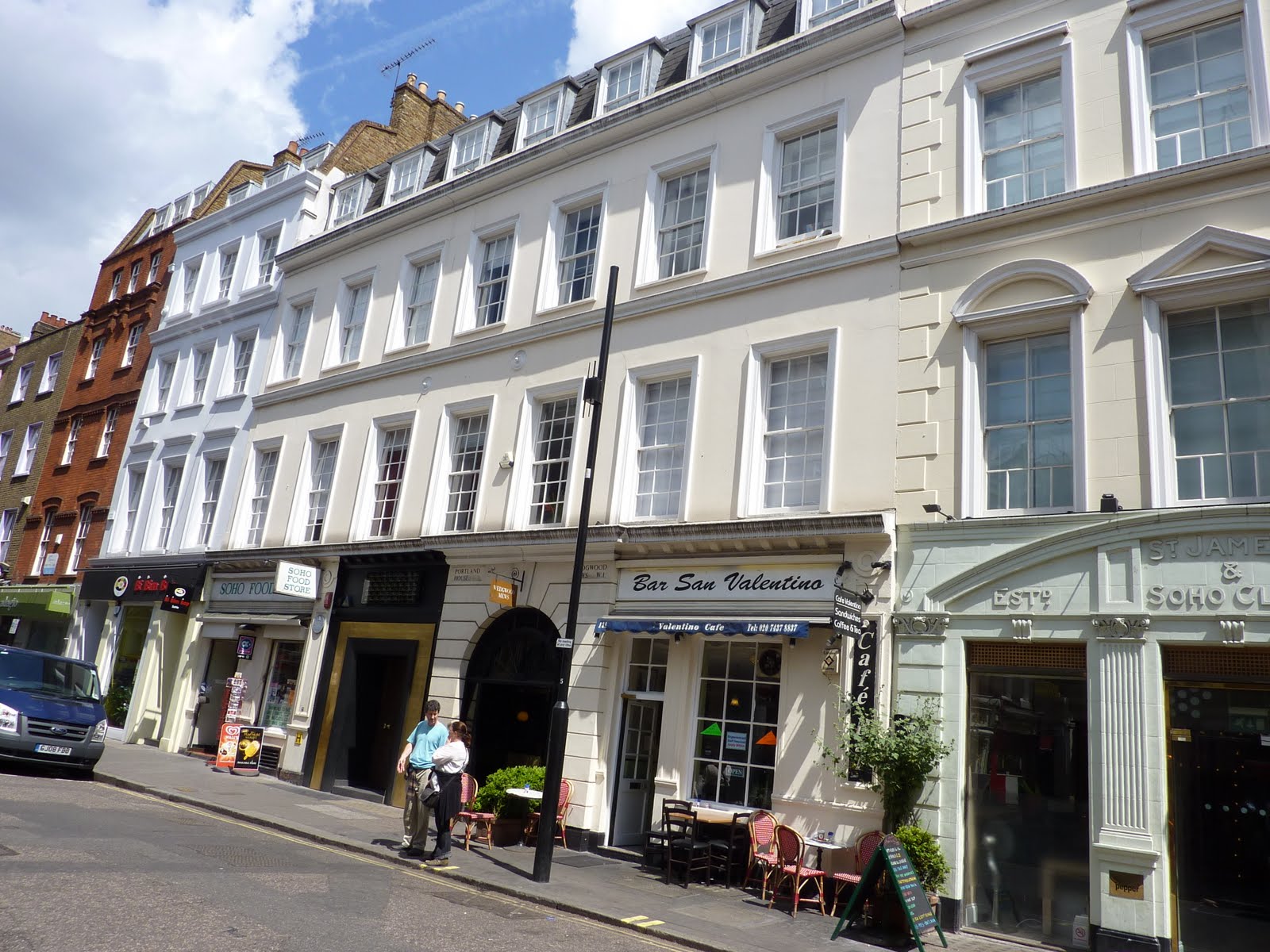
Still on my first afternoon in London, I walked past the British Museum an few steps past my hotel and wandered along Greek Street. While the buildings date back to the 18th century, most of the facades were added in the early 1900's.

Here we see the The Seven Pillars of Hurcules Pub with its 1733 structure and updated front. Dickens referred to this pub and a couple of other buildings in this street in his Tale of Two Cities.

The story of course is set during the the Rein of Terror in France, which is something that interests me as a writer.

The buildings beside the pub were also from the 1730's but were updated during the early 1800's.

This building, numbers 12-13 the largest in Greek Street was originally named Portland House.

From 1794 until 1797 Josiah Wedgewood displayed his wares here.
The rooms mentioned on the ground floor were a 'Hall', 'Counting house' and 'Shop' and on the first floor a 'Great room', another room, a 'Flowerpot room' and a 'Gallery'. Outside, mention is made of 'Painting Shops, Stable, damaged ware room, Scowering room, retort room, Pearl ware room, Laboratory, Printing and Pattern rooms' and of a 'Chapel-Building with Packing and unpacking House'

The firm then moved to 8 St James Square.

My destination is Horse Guards. But I realize I have used up the time set aside for this blog and since I took quite a few pictures, I will save them for next time we go rambling in London.

Tuesday, July 6, 2010

Regency Fashion for July

by Michele Ann Young
Fashion. My favorite post of the month.
I could not resist this one, since it is so different from most of the gowns we see for the Regency.

This is, of course, a court dress. It is from 1808 from La Belle Assemblee.

One can imagine how awkward moving around in such a gown might be. It seems to be a polonaise style and this lady is lucky because she does not have a train to manage when she backs up, though doorways might be a problem.


As you can see, this next plate is from the Lady's Magazine from July 1810.

The Ball Dress is a pink gossamer satin slip, with Grecian frock of white Persian gauze, united up the front and round the bottom with silver filligree, buttons and chain; the bottom trimmed with a deep vandyke lace; Spanish slash sleeves, confined with silver filligree buttons and cord; hair à-la-Greque, with Persian roses; pearl necklace, bracelets, and ear-rings; shoes of white satin, spotted with pink foil; gloves of French Kid;  and a white crape fan.


The Promenade Dress is a Spanish pelisse of white and lilac shot sarsenet, trimmed with Chinese scalloped binding, ornamented up the front with the same, and fastened with correspondent buttons; a woodland hat with lemon-colored chip and a curled ostrich feather of lilac and white; complimented by lemon-colored slippers and kid gloves; gold neck-chain and broach; her ridicule is of painted velvet.

 I love the sound of a woodland hat. It is pretty and certainly reminds one of summer weather.

The Mammoth Book of Regency Romance


Until next time, Happy Rambles