I don't often give advice. But this past week I was at the optician's I let fall that I was a published author, as one occasionally does. The recipient of this information, a very nice man, offered that he had wanted to write a book, then decided that he didn't have anything to say that he thought others might find of interest.
Really? Don't we all have stories to tell? Even if it is only what happened at work today. It wasn't the time or the place to offer advice, nor was I asked for it, but here is some of what I might have said had I got it together.
I must say that unlike other authors I have met over these past several years, I had no thought of becoming an author. Yes I liked the challenge of crafting a clearly argued memo, or creating a well thought out report on some item of business but an author? No. I was an avid reader.
Until one fine day; I wrote a novel. What a surprise.
All right so it was a very bad novel, but I finished it.
Tip # 1
Finish the book.
You will hear authors say that a finished book can always be fixed. I would suggest that while it is likely true for some, not my first one. It was an exercise of undeveloped muscles. A training run. Never to see the light of day. You know all those things they say never to do in a book. I did them all. I had no clue, apart from writing THE END.
And then I took classes
Tip # 2
Learn your craft. Books on the subject. Classes. And above all reading books by authors you admire.
It took five more novels under my belt before I won my first contract. It was like winning the lottery.
Amazing.
Also quite painful. All those: thanks but no thanks. Interestingly enough all but one of those next books are now in print.
Tip # 3
Persevere
Don't give up. Don't second guess yourself. Or put yourself out of the running. Finish, polish and submit.
We all know the classic examples, Stephen King, J K Rowling etc. etc and Ann Lethbridge. Oh well, I couldn't resist (not that I am putting myself in their category, of course).
And a publisher is not your only option. These days, self-publishing or inde-publishing provides a whole other avenue of getting you're work out there. More on that another time.
Monday, July 7, 2014
Fashion for June
PROMENADE OR WALKING DRESS from Ackermann's Repository June 1812
A ROUND robe of jaconot or fine cambric muslin, with long sleeve and high waist, with fan ruff of lace, ornamented up the front with borders of needle-work or lace, and finished at the feet with ball fringe.
A Spanish hussar cloak of deep amber sarsnet, lined with sea green or white, and trimmed with broad thread lace, put on very full.
Hair disposed in bands and waved curls; a large square veil of white lace, thrown over the head and shading the face.
Half-boots amber-coloured kid, and gloves a pale primrose.
Small French cap of lace, ornamented with a small cluster of spring flowers, on one side, are often seen in this style of costume, and have an appropriate and pretty effect beneath the long veil.
Monday, June 30, 2014
Regency Fashion May 1814

Bourbon Hat and Mantle.
Frock of the finest jacconet muslin, embroidered round the bottom in fleurs de lis; the waist of the dress is the same length as last month, but the bosom and shoulders are not quite so much exposed; the bosom is ornamented with embroidery to correspond with the train. The back is full, and a narrow white satin sash is tied in long bows and ends behind. Three very small white silk fleur de lis ornament the dress in front of the bosom. Plain long sleeve.
The Bourbon mantle of azure crape worn with this dress is remarkably novel and elegant; it is ornamented behind with white satin, which forms the back in a manner perfectly original and singularly tasteful; the crape is cut at each side of the back in points, as is also the front; each point is ornamented with fleurs de lis and rich tasssels; the mantle is edged round with narrow byas white satin, and finished at the edge by a very light and elegant trimming, which we understand was invented expressly for it. A small byas white satin collar which falls over, is fastened in front with a pearl brooch, and edged with trimming to correspond.
The Bourbon Hat, patronized we understand by the Duchess d’Angouleme, is truly elegant, and admirably adapted to the season; it is in fact, a most novel and tasteful emblem of royalty; its form, which is peculiar, has never before been introduced, and it is decorated in a style of novelty, simplicity, and elegance; nor is it its least recommendation that it is completely portable, as it may be packed even in a portmanteau in scarcely any space, without its being in the least degree injured.
For the form of this attractive hat, we refer our readers to the Plate; the materials of which it is composed are azure satin, and fleurs de lis, with which it is ornamented in front, are composed of pearl; a light and beautiful trimming of floss silk intermixed with pearl, goes round the edge of the hat, and an ostrich feather is tastefully placed to the side. Parasol, gloves, slippers, and Bourbon ridicule to correspond.
A hat that travels well in a portmanteau is a must, I should assume. The Bourbon star was on the rise with Bonaparte signing the Treaty of Fontainebleau on April 13 1814 and agreed to his exile on Elba.
Naturally this momentous occasion warranted a complete outfit in honour of the Bourbons who were to be returned to their rightful throne.
Monday, April 28, 2014
Murder & Mayhem Regency Style
Romance writers beware, this is story extracted from the Belle Assemblee's Anecdotes of Illustrious Females for November 1813.
Mademoiselle De Scudery
This lady, who was a celebrated romance writer in the reign of Louis XIV (1638-1715) met with a curious accident when travelling with her brother, who also employed his talent in composing works of fiction and being at that time engaged in writing together a work when on their journey at a considerable distance from Paris they began to speak of the various incident they meant to bring forward in the course of the composition; the hero of with they had named the Prince Mazare.
"What shall we do with Prince Mazare?" sad Mademoiselle Scudery to her brother; "is it not better that he should die by poison, than b a poniard?"
"There is time enough yet," said her brother. "We can dispatch him when we please, but we have not yet done with him."
Two merchants in the next apartment overheard this curious conversation, which they concluded intimate a conspiracy for the murder of some Prince, whose real name these cruel people had disguised under that of Mazare. Full of this discovery, they immediately told their suspicions to their landlady of the inn, who with the merchants resolved to acquaint the police officer with what had happened. The officer immediately put the travellers under arrest, and escorted them, strongly guarded to Paris; and it was not without extremely difficulty and expense that they procured their liberation.
The moral of the story is -- be careful who is listening while you brainstorm your story
Until next time.
Monday, April 21, 2014
Regency Fashion April 1814
This Morning Dress pairs with the previous plate.
Also from Ackermann's Repository for April 1814
A petticoat and bodice of fine jaconot muslin, finished round the bottom in vandykes and small buttons.
The Rochelle spencer is composed of the same material, appliqued with footing lace down the sleeve, and trimmed at the edge with a narrow but full border of muslin. Double fan frill of muslin round the neck, very full, continuing round the bottom of the waist, where it is gathered on a beading of needle-work.
Bourdeaux mob cap, composed of lace, with treble full borders, narrowed under the chin. A small flower placed backward, on the left side. Hair much divided in front, and in full waved curls on each side. Necklace of twisted gold and pearl, with pendent cross in the centre.
Spring Greek kid slippers; and gloves of the same.
The beautiful cloak given in our last Number, as well as both the dresses in this, are from Mrs. Gill, of Cork-street, to whose taste and invention this work as well as the world of fashion are under continued obligation.
Until next time
Thursday, April 17, 2014
Return of the Prodigal Gilvry
In stores now. This is the last book in the Gilvrys of Dunross Series. Each book can be read alone but you may not want to miss each brothers story. I am sad to be saying goodbye to them, I must say.
The e-book will be able on May 1 and is available for preorder.
BEHIND THE HIGHLANDER'S SCARS… Reeling from betrayal, the once devastatingly handsome Andrew Gilvry has returned to Scottish shores to fulfill a promise made to a dying man. The widowed Rowena MacDonald has been entrusted to his care, and Drew must do all he can to protect her…. LIES A DARK PASSION! But Drew's honor is about to be tested—because there's something in Rowena's dove-gray eyes that awakens a flame long extinguished. And on a perilous journey across the Highlands, with only this alluring woman for company, how long can he deny his desires?
Amazon.com
Chapters.ca
Amazon.ca
Don't forget to check my website to find out more. Until next time
Monday, April 14, 2014
Regency Fashion April 1814
The first of our fashion plates for this month is a Promenade Dress. It makes sense that we are starting to think about walking in Spring.
This is from Ackermann's for April and the description is as follows.
A fine cambric round robe, with high bodice and long sleeves, not so full as of late; embroidered stomacher front and high collar, trimmed with muslin or lace; a Tuscan border of needle-work at the feet.
A Cossack mantle of pale ruby, or blossom-coloured velvet, lined with white sarsnet, and trimmed entirely round with a broad skin of light sable, ermine, seal, or the American squirrel; a short tippet of the same; the mantle confined at the throat with a rich correspondent silk cord and tassels, very long.
A mountain hat of velvet, the colour of the mantle, finished round the verge with a narrow Vandyke trimming: a small flower placed in the hair beneath, on the left side.
Half-boots the colour of the mantle; and gloves of primrose kid or pale tan.
I thought this quite pretty. And I was interested in the term, mountain hat and the use of American squirrel.
Until next time.....
Thursday, April 10, 2014
Montacute House III
Our next part of the visit is to the Parlour. Oddly, I wrote this blog before, but the text and pictures disappeared. The great mystery of the age. Onward.
Luckily for us this room while it has had several purposes, it has retained its chief features. In Georgian times it was used as a dining room.
The fireplace is something to behold, but of course one need to ignore the hot water radiator placed in the middle of it. It is made of Ham Hill stone. The upper register is decorative plaster over strapwork.
This gilt over walnut furniture dates from George I which along with the screen you will see later are embroidered in gros and petit point. As a stitcher I one can imagine the hours of work that went into them.
The tapestry is a c 1731 Gobelins of the Hunter.

The wainscoting is thought to be original and certainly in the room in 1667.
This is a George II gilt sidetable with cabriole legs.
Lots more to see, next time
Monday, April 7, 2014
Give Away ~ Return of the Prodigal Gilvry
Return of the Prodigal Gilvry
My last book in the Gilvrys of Dunross Series is currently being offered as a goodreads give away. You can sign up through the widget in the sidebar.
BEHIND THE HIGHLANDER'S SCARS…
Reeling from betrayal, the once devastatingly handsome Andrew Gilvry has returned to Scottish shores to fulfill a promise made to a dying man. The widowed Rowena MacDonald has been entrusted to his care, and Drew must do all he can to protect her….
LIES A DARK PASSION!
But Drew's honor is about to be tested—because there's something in Rowena's dove-gray eyes that awakens a flame long extinguished. And on a perilous journey across the Highlands, with only this alluring woman for company, how long can he deny his desires?
My last book in the Gilvrys of Dunross Series is currently being offered as a goodreads give away. You can sign up through the widget in the sidebar.BEHIND THE HIGHLANDER'S SCARS…
Reeling from betrayal, the once devastatingly handsome Andrew Gilvry has returned to Scottish shores to fulfill a promise made to a dying man. The widowed Rowena MacDonald has been entrusted to his care, and Drew must do all he can to protect her….
LIES A DARK PASSION!
But Drew's honor is about to be tested—because there's something in Rowena's dove-gray eyes that awakens a flame long extinguished. And on a perilous journey across the Highlands, with only this alluring woman for company, how long can he deny his desires?
I must say, knowing this is the last time I will visit the characters in these books is very sad. I have grown fond of them. And yet... there are lots of other stories floating around in the mish mash of my brain. Stories I have been wanting to write for ages.
Until next time...
Until next time...
Thursday, March 20, 2014
Regency Murder and Mayhem
A new series of articles to appear from time to time for your edification. These are Taken from the Belle Assemblee February 1814
Lighting Strike
The lightning on Tuesday, February 9, slightly struck Richardson's hotel in Covent Garden, passing between a crowd of people who were standing up for shelter there, but providentially without doing injury to any one. It broke two panes of glass in the kitchen window, but did not other mischief.
Shocking Accident
As General Darican, so well known in Paris, when he commanded sections against Bonaparte, and who resides in the Polygon, at Somers Town, was riding along Union-street, his horse took fright, and galloped off with him. The animal on reaching the end of Union-street, plunged into a hole about twenty feet deep, and threw his rider, who received a severe concussion of the brain. He was immediately conveyed to the house of a respectable surgeon in that neighbourhood, but he is not expected to recover. The horse was afterwards tken up dead from the effect of the fall.
I was unable to determine if he did indeed succumb to his injuries.
Monday, March 17, 2014
Regency Fashion March 1814
This is an evening dress designed to be worn during a period of mourning.
The description from La Belle Assemblee for March 1814 is as follows;
Half dress of French grey crape, over a white satin slip, which is slightly embroidered round the bottom with grey chenille. The half dress is sloped so as to be about a quarter of a yard longer behind than in front, and is richly embroidered in white silk round the bottom, which has a very elegant effect; the body a-la-chemise, is made with a little fullness, and drawn in to the waist by a white satin sash.
An embroidery to correspond with the bottom goes round the bosom, which is cut very low, and the back of the neck. The sleeves are extremely tasteful; they are composed of grey crape on white satin, and are gauged at a distance of about two inches all down; each gauging is finished with a row of pearl, and two rows of pearl at about two inches distance finish the sleeve at bottom.
Bonnet of French grey crape, turned up on one side and slouched on the other, ornamented with a very long white feather. White crape fan. Bracelets, necklace, and earrings of pearl. White kid gloves and shoes.
Until next time
Regency Fashion - March 1816
Opera or Walking From La Belle Assemblee
The plate says opera, but the description says walking. I will let you decide, but I'm thinking, well its spring, let us walk to the opera.
Here is the official description:
Round dress of jaconet muslin, made high to the throat, and rather longer in the waist than last month. Long sleeves gauged about the wrists about an inch; the sleeve is left about two inches in length from the gauging, and is edged with a very fine narrow lace. The collar, which is made tight to the neck, is also edged with a lace to correspond. A very rich embroidery goes round the bottom of the dress.
The Huntley bonnet and scarf, for which we refer our readers to the Plate, have a very elegant effect; they are composed of rich twilled plaid sarsnet; the scarf is three yards in length, it is a straight piece, and is disposed according to the taste of the wearer.
A beautiful Prince's plume ornaments the bonnet. Very pale tan slippers and gloves.
I like the dress, but not so much the plaid, but it would be good for walking.
Until next time
Thursday, March 13, 2014
Montacute House II
Here is the front door which says
Through this wide op'ning Gate
None come too Early none Return too Late
This is a quote from Alexander Pope's Second Satire of the Second Book of Horace, Paraphrased and come from a speech of an upper class ne'er do well, thought to have been added in the nineteenth century to the East frontdoor of this 17th century house
The coat of arms above the porch into the door are those of the house's builder, Sir Edward Phelips 1560- 1614 and dated 1601.
The door opens into the screens passage at one end of the Great Hall.
In this picture you can see the open door, and the passage behind the screen. This passage divides the great hall from the dining room.
And of course the screen itself.
It really is beautiful. It is a single story screen.
By this time, great halls were where the lord met his guests and took them up to the first floor private dining room. At one time, the floor was tiled. I am sure it was used similarly in our time.
The fireplace and paneling on this wall are original.
The stained glass in the windows is heraldic with the coats of arms of
Elizabeth the first and Sir Edward Phelips and his brothers.
At the other end of the hall is a plaster frieze that shows a story of what might happen to a man who strikes his wife with a shoe.
Until next time
Through this wide op'ning Gate

None come too Early none Return too Late
This is a quote from Alexander Pope's Second Satire of the Second Book of Horace, Paraphrased and come from a speech of an upper class ne'er do well, thought to have been added in the nineteenth century to the East frontdoor of this 17th century house
The coat of arms above the porch into the door are those of the house's builder, Sir Edward Phelips 1560- 1614 and dated 1601.
The door opens into the screens passage at one end of the Great Hall.
In this picture you can see the open door, and the passage behind the screen. This passage divides the great hall from the dining room.
And of course the screen itself.
It really is beautiful. It is a single story screen.
By this time, great halls were where the lord met his guests and took them up to the first floor private dining room. At one time, the floor was tiled. I am sure it was used similarly in our time.
The fireplace and paneling on this wall are original.
The stained glass in the windows is heraldic with the coats of arms of
Elizabeth the first and Sir Edward Phelips and his brothers.At the other end of the hall is a plaster frieze that shows a story of what might happen to a man who strikes his wife with a shoe.
Until next time
Monday, March 10, 2014
Regency News and Adverts
La Belle Assemblee 1813, March
Here are a couple of pieces you might find interesting
Married
At Warrington: Mr. William Leather, breadmaker, to Miss Nanny7 Holland, confectioner, after a tedious courtship of thirty-six years.
Do you think the marriage was less "tedious". Do you think combination of baker and confectioner was all about business?
Died
The Hon. Harriet Pryse, Lady of Pryse Pryse, Esq. of Gogerddan. This afflicting event was occasioned by the following accident:
As Mrs Pryse was preparing to go to bed, between two and three o'clock, on the morning fo New Year's day, her night-dress came in contacts with a rushlight that was burning in the room, and was instantly in a blaze.
While this last is not happy topic it contains some useful gems from speech at the time. I was interested in the use of a rush light give that this woman is clearly not of lower orders. But candles were expensive.
Advertisement
Rowland's Essence of Tyre;
Or Imperial Dye,
A Chemical peparation of wonderful metamorphosing powers,. for emmediately and effectually change the Hair when Red or Grey, to a beautiful Black, Brown, or Auburn. Price 7s 6d. per bottle.
Clear evidence that red hair is worse than grey? What do you think?
I hope you enjoyed this mornings offerings. Please comment so that I can continue this blog.
Until next time, if there is a next time.......
Monday, March 3, 2014
Montacute House I
Moving on from Devon, we find ourselves in Somerset.
At Montacute House.
A house built in the late fifteen hundreds. by Sir Edward Phelips.
The warm stone came from nearby Ham Hill and has been described as "the most beautiful Elizabethan House in England".
It must be noted that little of the original furnishings remain from any of the eras in which we might be interested, but the building and the decoration is original and would have been so during the Regency.
These external views show an extraordinary house.
This is a view of the east front, the principal front of Montacute. and is designed in the typical "E" formation from this period. It also follows the height of Elizabethan fashion with its extensive areas of glittering glass. A hugely expensive proposition at this time.
Between each window on the top, third, story, and on the gable of the central bay are statues of the nine worthies - Joshua, David, Judas Maccabaeus, Hector, Alexander, Julius Caesar, King Arthur, Charlemagne and Godfrey of Bouillon.

The house is topped of with Flemish-type gables, whose curves were a fashion imported in the late 1570s
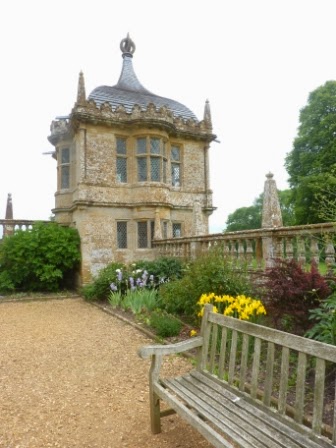
This is a pavillion, one of a pair each side of the forecourt at the east front were built and used as extra bedrooms.
There will be much more to come about this lovely house.
Until next time, Happy Rambles
Monday, February 24, 2014
Regency Fashion February 1814
I am squeaking this one in before we hit the end of the month. You may have noticed the pattern. I am trying to give you dresses exactly 200 years old. I have another couple for this month so I am going to put them in later this week, so you have them all. Back to regular scheduling for March.
While the title on the plate says "Dinner Dress" The description calls it a Carriage Pelisse. I assume the two are not incompatible, and it is a carriage dress one could wear to dinner. It is certainly gorgeous enough to go anywhere and the detail says that each of those little tassels is a tie. Heaven help the poor maid having to do that one up and clearly one wouldn't be removing it when one arrived for dinner. I love the elegant lines of this gown despite the fussiness of the trim.
Here is the description for your delectation and delight from La Bell Assemblee January 1814 issue, February Fashions.
Orange Boven Carriage Pelisse
A pelisse of the most delicate fawn colour Irish poplin, the skirt an easy fullness, the body tight to the shape, very short in the waist, and broad in the back.
The front, as our readers will see by the Plate, is very elegantly ornamented with white satin points put on at each side of the front; a beautiful white silk trimming edges each point, and white silk tassels of the lightest and most beautiful texture tie the pelisse all down the front.
The sleeve is ornamented in a similar manner on a smaller scale, but without the tassels: the bottom of the pelisse and the cuffs are also ornamented with white satin points, edged with silk trimming to correspond, and on each hip is a very novel and tasteful ornament, about the size of a large Spanish button; it is composed of floss silk, in the form of a shell.
A ruff of white satin cut in points, encircles the throat; it is supported, we believe, by ribband wire, or something of that sort, as it stands up round the throat, it is edged with a very fine narrow white lace. Head-dress a small Spanish cap of white satin, or fawn coloured velvet, tastefully ornamented with points edged with pearl, and a superb white ostrich feather, which falls to the left side. Fawn colour slippers and gloves. We have no hesitation in saying that this dress is the most elegant and novel that has appeared in the carriage costume for a considerable time.
Elegant and novel. I would have to agree. Until next time, Happy Rambles
Thursday, February 20, 2014
Fashion for February 1814
This is an evening gown from Ackerman's Repository for February 1814, described as an Evening or Dancing
The length clearly allows for some jigging about in those very energetic country dances.
A white crape petticoat, worn over gossamer satin, ornamented at the feet with rows of puckered net, with a centre border of blue satin or velvet, in puffs.
A bodice of blue satin, with short full sleeves, and cuffs to correspond with the bottom of the dress. A full puckered border of net, or crape round the bosom.
Stomacher and belt of white satin, with pearl or diamond clasp.
Hair in disheveled curls, divided in front of the forehead, and ornamented with clusters of small variegated flowers; a large transparent Mechlin veil, thrown occasionally over the head, shading the bosom in front, and falling in graceful drapery beneath.
Ear-rings, necklace and bracelets of Oriental pearl, or white cornelian.
Slippers of white satin, with blue rosettes. White kid gloves; and fan of spangled crape and blue foil.
I like the idea of disheveled curls, don't you?
Until next time......
Monday, February 17, 2014
Coming Soon
Here is your official Sneak Peek at my next cover and a little bit about the book.Return of the Prodigal Gilvry
BEHIND THE HIGHLANDER'S SCARS…
Reeling from betrayal, the once devastatingly handsome Andrew Gilvry has returned to Scottish shores to fulfill a promise made to a dying man. The widowed Rowena MacDonald has been entrusted to his care, and Drew must do all he can to protect her….
LIES A DARK PASSION!
But Drew's honor is about to be tested—because there's something in Rowena's dove-gray eyes that awakens a flame long extinguished. And on a perilous journey across the Highlands, with only this alluring woman for company, how long can he deny his desires?
This is the last of the Gilvrys of Dunross series (boy, I am going to miss the Scottish Highlands), The series was a spin off from Captured for the Captain's Pleasure and I am wondering if I should write Jaimie's story. He plays a much a very small part in several of these book. I suppose it will depend on popular demand.
Until next time .... well you know the drill.....
Monday, February 10, 2014
Fashion for January 2014
Today's offering is a Morning Carriage Dress from the December edition of La Belle Assemblee.
It think this outfit would have been perfect for February too. The description is as follows.
Pelisse of the fashionable blue cloth, fastened down the front with small flaps, edged with silk trimming to correspond, in a manner that is perfectly novel, and that has a very singular effect; the cuff is also ornamented to correspond.
A very small cottage bonnet, composed of white satin, and of a most becoming and novel shape; the front, which is very small, displays a rich quilling of lace to correspond with the triple lace ruff.
The bonnet on the front is ornamented with a white satin ribband, which is so disposed as to have the appearance of a small wreath of white flowers; a white soft ribband ties it in a very full bow under the chin. Cloth half-boots to correspond with the dress. York tan gloves, and a seal-skin muff and tippet, finishes this dress.
Our modern day preferences would no doubt have us omitting the fur accoutrements, but since this is history, we include them.
Until Next time, Happy Rambles.
Monday, February 3, 2014
Gentlemen's Clothing
On the issue of a gentleman's pockets.
There has been some discussion among those who undertake research on the Regency about the issue of where a gentleman might "put stuff on his person and quite often asserting that men did not have pockets in their pants (as we call them today).
I just read the following in La Belle Assemblee for January 1813, a description of an altercation regarding payment of his bill, between a Navy lieutenant and his host at a Tavern , namely the Horse and Groom Tavern, near the Asylum, London.
"...a waiter was directed to follow him and saw him, whilst in his room, put a dagger into the pocket of his pantaloons; some further altercation ensued and he drew the dagger, and pointed it at the plaintiff."
So clearly pockets large enough for a dagger of polished steel with a broad keen blade some six inches long were included in the construction of men's pantaloons. If I come across more detail, I shall be sure to add it to this snippet.
I should add the the officer offered the dagger to the judge as a gift, who took it and then told the lieutenant he must still find bail money to answer to the charge of an assault of an aggravated nature at Sessions, desipte the officer explaining that there was no altercation, he simply intended to show his friends the dagger.
Subscribe to:
Posts (Atom)