Wednesday, July 25, 2012

Marnhull, Dorset

There has been a village in Marnhull since Saxon times. It is located in the Blackmore Vale an area often called Hardy country.The village has around 2,000 residents

The church, St Gregorys, is very old and well worth a visit. The first church was built on this site in the twelfth (isn't that such an odd looking word) century. 

There is evidence of that church in the current building and one of the original pillars holds up part of the roof. 


As you can see, whoever carved those original capitals had a sense of humour. The faces likely represent the men who worked on that first church.  If so, it is nice that they have been captured this way, since rarely do we see the workers in portraits etc.


The church was enlarged on and off throughout the medieval period.The west part of the nave is coffered work from 1520 and there is a sixteenth century wagon roof in the north aisle. 


There is also a squint, or a hagioscope which permitted the congregation in the north transcept to see the high point in the mass when the consecrated host was elevated by the priest.

The altar is from the 17th century and here you see it decorated by the local ladies for the Jubilee celebrations.


The original 16th century paintings of the ten commandments, of which only scraps remain, are  mostly covered over by18th century paintings of the creed and the Lords prayer.

I hope you enjoyed this visit to an ancient English country church, until next time, Happy Rambles.

Thursday, July 12, 2012

Sherborne


Some time ago, we visited Sir Walter Raleigh's Sherborne castle in Dorset.  Nearby is the ancient and charming town of Sherborne.

Set on the River Yeo edging onto the Blackmore Vale, the town is a picturesque mix of buildings, including those from medieval and Georgian eras.

I loved this archway.  Many of the buidings are constructed of  ochre-coloured hamstone from Ham Hill in Somerset.

Sherborne was the capital of Wessex and two of King Alfred the Great's older brothers are buried here in the abbey.

The Abbey was once a saxon cathedral and is now the Parish Church.


The Conduit is a hexagonal 16th-century building that originally stood in the cloisters on the north side of the abbey, where it served as a washing place for the monks. It was moved to  the southern end of Cheap Street after the dissolution of the monastery in 1539.


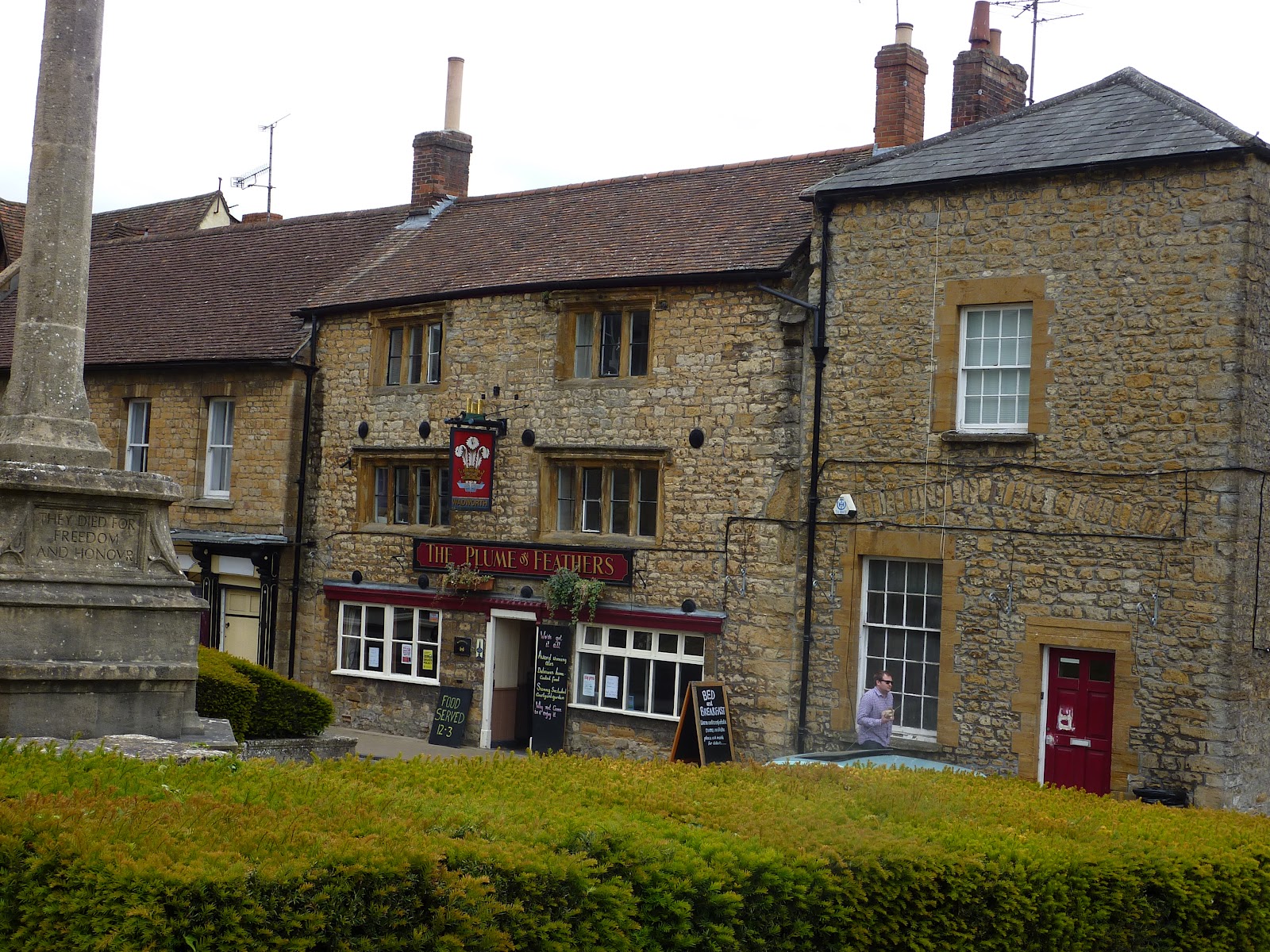
 I could not resist this street sign, since it also a street name that often appears in many of my favourite Georgette Heyer novels set in London. And of course there we find a 17century pub.

 Sherborne School for boys was founded by King Edward VI and occupies some of the original Abbey buildings.  I can imagine a Regency character attending school here, can't you?


The St John's Alms Houses

This building was licensed by Henry VI in 1437 and was designed to house ‘twelve pore feeble---old men and five pore feeble---old women’. Copies of the royal license and foundation deed are on view in the antechapel.

The construction of the almshouse began in 1440; the chapel was completed two years later and the remainder of the building in 1445. Eighteen elderly people from the town are still housed there today.  How about that for long term planning?

Here are a couple of lovely half timbered building from Tudor times.


And last but not least, although there are many Georgian buildings in the town, I fell in love with this one.

 Built in 1818 it was originally the Sherbourne Bank for saving.

And since I found my perfect Regency building, it is time to call it a day and wish you Happy Rambles Until next time.


Thursday, June 28, 2012

Find me

I do hope you have been following along.  Saturday concludes our story. Can you guess who Lady Ambleforth chooses? http://harlequinhistoricalauthors.blogspot.ca/

Monday, June 25, 2012

Book News


It is always exciting when a new book comes out. Exciting and scary too.  Here is my latest offering, The Laird's Forbidden Lady is now in stores and on line where ever you like to shop


Ian Gilvry, Laird of Dunross, is as rough and wild as the Highland heather. Yet the return of Sassenach Selina and her family to claim his land ignites hatred and passion in equal measure.


Lady Selina is torn between family loyalty and wanton need for Ian. Tricked into marriage, she finds the laird fulfils her every burning desire. But Ian is a man bound by duty. Can Selina be sure that his heart belongs not only to his clan…but also to the woman he has made his wife?


This Regency is set in Scotland and has received a great review from Romantic Times which I am delighted to share with you:

For fast-paced, pulse-pounding action and adventure merged with a highly passionate romance, Lethbridge’s latest is hard to beat. The engaging characters, along with the plot, evoke the atmosphere, people and history of Scotland. Fun, fast and fabulous! - Romantic Times


Winner of the Romantic Times K.I.S.S. (Knight in Shining Silver) July 2012.

Buy here from Amazon.com: The Laird's Forbidden Lady (Harlequin Historical)
Buy here From Barnes And Noble icon

Thursday, June 7, 2012

Fashion 1812

Here we have some beautiful examples of day's worth of dress for March 1812.  A walking and evening gown for the same month.

Taken from the Lady's Magazine and described as follows:


Walking Dress.

A spencer of blue silk, with facings, collar, wings, and cuffs of plush to match. --A bonnet composed of silk and velvet, to agree in color with the spencer.--Feather, the same.

Evening Dress

An evening dress f pink silk, either flowered or plain, trimmed with crape of the same color, and ornamented with small white buttons.--Cap of velvet and lace, trimmed with footing and a flower.

These two gowns to me seem to epitomize the Regency Era in their style.

Until Next Time  Happy Rambles

Monday, June 4, 2012

Harlequin Authors Summer Beach Bag Contest

This is the first day of our Summer Beach bag contest. 


Here is the Calendar of events to get you started. It's vacation season and excitement mounts as that long-awaited time at the beach approaches. To add to your anticipation, some Harlequin Historical authors are offering a bevy of prizes to fill your beach bag with fun items (and BOOKS of course!) for that relaxation time. Each participating author will have an activity planned on their website for their special day. You may be asked to comment on a blog, do a scavenger hunt, or visit a Facebook page. For each day you participate, your name will be entered into the Grand Prize drawing.

Thursday, May 31, 2012

Fashion 1812

Here we are moving along rapildy in the second year of the Regency, and it is time for another look at the fashions.

This is a really quite magnificent gown, isn't it?  It is for February 1812, therefore at the start of the 200th anniversary of the second year of the Regency.

As described in La Belle Assemblee

Evening Costume
    An amber crape dress over white sarsnet, trimmed with pearls or white beads, with a demi-train; a light short jacket, rather scanty, with two separate fancy folds, depending about three quarters down the front of the skirt, forming in appearance a kind of Sicillan tunic, and trimmed down each division like the bottom of the dress, with a single row of pearls; short sleeves, not very high above the elbow, fitting close to the arm, and ornamented at the top with distinct points of satin, the same colour as the dress, relieved by pearls; two rows of the same costly material or beads, according as the robe is ornamented, form the girdle.
The hair dressed in the antique Roman style, with tresses brought together and confined at the back of the head, terminating either in ringlets or in two light knots; a braid of plaited hair drawn over a demi-turban formed of plain amber satin, with an elegantly embroidered stripe of white satin, separated by rows of pearl, and a superb sprig of pearls in front. Necklace of one single row of large pearls, with earrings of the Maltese fashion to correspond.
Ridicule aus getons of slate colour, shot with pink;  the firm base secured by a covering of pink stamped velvet, with pink tassels. Italian slippers of amber, fringed with silver, or ornamented round the ankle with a row of pearls or beads. White kid gloves.—This elegant dress owes its invention to the tasteful fancy of Mrs. Schabner of Tavistock-Street.

We are treated to a whole raft of terminology in this description.  From the antique Roman style hair, Maltese earrings to Ridicule aus getons.

I hope you enjoyed this gown, we will have some more Spring Fashions very soon. Until next time, Happy Rambles.

Monday, May 28, 2012

Weymouth

If you are following the Olympics you will no doubt have noticed that Weymouth in Dorset, on the south coast of England, is the venue for some of the water sports, in particular, sailing.  As you can see from this picture it looks ideal

But that was not why I went to Weymouth.  Weymouth was one of George III's favorite places.  It is where he went for his summer holidays, before Prinny, the Prince of Wales, his son made Brighton famous.  It was his brother the Duke of Gloucester who built Gloucester (pronounced Gloster for those who like to know) House and the King spent fourteen holidays there over the course of many years.

It is a very old seaport, but has become a tourist place probably because of the Royal patronage initially.  But it really does have a very beautiful beach with find soft sand. 

Here is a statue erected to the King by the Town in celebration of George III's 50 years on the throne.  And I thought you might like a close up of the old fellow.


This is Gloucester Lodge where the King spent his holidays, it is right on the sea front, The Esplanade. There is a road and a walking promenade and then the beach.  So nothing in the way of the view of the sea and the bay.

Just a few steps along from here is the Royal Hotel. It is a Victorian building built on the sight of the Old Royal Hotel which also provided the public Assembly Rooms which would have been in use during the Regency. The are a number of Georgian and Regency buildings along The Esplanade.

Running parallel to the esplanade and behind the buildings which face the sea is St Mary's street with shops and restaurants and an old pub now called the Black Dog but was called The Dove Ale House in George III's day.  Apparently the King was a regular customer.  It also happily boasts of a murder on the premises.

Hope you enjoyed your visit to the seaside. Until next time, Happy Rambles

Thursday, May 24, 2012

Punch and Judy at Weymouth

Hands up if you have ever seen a Punch and Judy show!  I have nearly always seen them at the seaside in Britain, pretty much as you see this one pictured here.  It is basically a glove puppet show with a formulaic and traditional story designed to get the audience, these days usually children, involved.  A "look behind you" sort of feverish yelling.

I wonder how many of the characters you can remember, Mr Punch, Judy his wife, the baby, the policeman..... don't forget the sausages!

Punch and Judy, or Joan as she was known in the early days, has been around a very long time. Originally showing up in marionette (puppet on strings) theatres, they gradually moved to  the narrow box like structure you see in the picture. Originally they might be covered with any kind of fabric, such as mattress ticking, but over time the red and white stripes became the stock in trade. The puppeteer works inside the box with the puppets appearing on the tiny stage and his bottler drawing the crowd and passing the hat for money.

In the Regency, you might have seen the show at a fair or on a street corner. Anywhere, in fact, that a crowd might gather and be convinced to part with a copper or two. But watch out for the ever present cutpurses.

I have quite a bit more to tell you about Weymouth, and in fact hadn't planned to talk about Punch and Judy at all. I had quite forgotten taking this picture, but when I saw it, I decided to talk about it instead. Oh, I think there was a hangman in it too.

Until next time, Happy Rambles.

Monday, May 7, 2012

Falmouth

Falmouth was one of the last places we visited on our trip to
Cornwall.

The Cornish word for Falmouth is Aberfal.

Together with Carrick Roads it forms the third deepest harbour in the world, so I am told.  Quite a feat when you think of the length of coastline around the world.

Because of the harbour and the estuary it has always been an important port in the defense of the country, hence the twin castles built in the 1540's on the headlands on either side of the entrance to the harbour. 

Of interest to me was the role of these defenses between 1807 and 1813 when Falmouth acted as a re-supply base for the British Army while at war with France in Spain and Portugal .   We visited Pendennis.  The castle was modified during later wars so one has to pick and choose what is relevant to our time.


This shot shows the gun battery as in the 1730's overlooking Carrick Roads.  In the foreground is the field train shed, and is the remaining half of an original structure build in 1805 for a field train of mobile guns, wagons, gun carriages, wheels and baggage, stored until needed

The tower itself was built as a gun tower, with guns to be fired on all three levels. By our time, the tower was used for living space, with the guns outside, and on the roof. The small round tower on the very top being a look out turret.


There were many changes made to the castle during the Napoleonic wars which were changed again in the late nineteen early twentieth century.  In particular a half moon battery was placed just outside the Elizabethan fortress with a command of the sea.  At the height of the war, Pendennis was defended by 22  24-pounder cannon, 14 18-Pounders and 12 carronades.  Meanwhile Falmouth along with Plymouth formed the main supply depots for the British Army. During this time, mail packet ships were armed with cannon. Many building went up at Pendennis, including barracks and a hospital.

Here is a video of what the gun platform might have looked and sounded like in the castle's earliest days.

So that last is just a bit of fun, if it doesn't interest you pass on by.

Until next time, Happy Rambles

Friday, May 4, 2012

News

Gosh, blogger has changed again. Hopefully this post will work the way it is meant to.
First, my  book, the Haunting of Beresford Abby is finished and sent in. Yay! So I can get back to chatting. I find I get very focussed when I am at the end of a book, and can't do anything else, so if you noticed I was missing, that was why.
Second, Contest finals


Lady Rosabella's Ruse is a finalist in the Greater Detroit Booksellers Best Awards, results will happen at the RWA National Conference in July


And both the Gamekeeper's Lady and Captured for the Captain's Pleasure are finallists in the Golden Quill Contest run by the Desert Rose Chapter of RWA.

The results of this will be announced in June. Two books in one contest, now that is quite extraordinary.
Thanks so much to the judges who obviously liked these stories.


Thirdly, and by no means last

Here is the cover for my July Book.  The Laird's Forbidden Lady.  Now, what do you think of the cover?  Yummy scruff of beard, do you think?


This book is available June 19 in some places and July 1 in others depending on how the scheduling works for the format, location you choose.


That is it. You are all caught up, so we can get back to regular programming. Until next time, Happy Rambles


Friday, April 20, 2012

More Tin Mining in Regency Cornwall

Back down the mine, here is a miner having his tea break.


And this next is a video. You will not see anything, it was too dark, but you can hear the constant sound of water. And a little bit of our guide.  But it was the sound I wanted to capture. You can almost imagine the water rising up to fill those tunnels.


And how did they get rid of all that water. Well there were a couple of pumps available, a bucket lift for shallow depths and a rag and chain pump.

These diagrams show the rag and chain pump in action.  The next picture shows part of the bucket lift.


This next picture is of the stamping machine, you an see the water wheel behind it that drove the heavy weights used to crush the ore so it can be smelted.

They say that sailors used the noise of these machines located at the cliff top mines to navigate the rocky coastlines and I think this next video will explain why.

I have a few more tidbits to tell you about the mining of tin, but hope this is enough to keep you going for now, since I have a book to finish. :)

Until next time, Happy Rambles.

Monday, April 16, 2012

RT Roundup


Back home, it all seems a bit of a blur, but I had to share this picture of the book signing. I had two books to sign, Lady Rosabella's Ruse and Captured for the Captain's Pleasure.

Speaking of another kind of pleasure it was a delight to meet so many enthusiastic readers.

There were over 300 authors at the signing last Saturday and lots and lots of people who came to see them.


Here are four of the Hussies (Harlequin Historical Authors) after a lunch and a stroll in the sun. It was a lovely day for a walk.  From left to right, Ann Lethbridge (me), Blythe Gifford, Deb Marlowe and Michelle Willingham.
And here are the gift bags the Harlequin Authors put together for the Wednesday event, with Michelle Willingham and Blythe Gifford admiring their hard work putting them together. Of course we could not have done it without Kimberly Lang who was our Captain and got us all organized. She writes for presents and I am very much looking forward to reading her book.

Well that is it. Home again and looking forward to getting back into routine, until next time  Happy Rambles

Thursday, April 12, 2012

Readers Are Such Fun

 #RomanticTimes Convention

Here we are, the Harlequin authors, at Celebrate History, Action and Homtown Heroes setting up for our wonderful readers to come and play with us. As you can see, lots of books to give out, goody bags being packed by the lovely Michelle Willingham and in the background our famous Superromance Author (RITA winner) Molly O'Keefe unpacking all the books Harlequin so generously sent us.


Here we are, mixing and mingling and getting ready to play our pub quiz. You can see all the books in the foreground, including Lady Rosabella's Ruse.

The elegant lady in blue is Blythe Gifford.  See who else you can spot among the authors and the readers.

Well, the results?  Molly O'Keefe knows her romance. Her group came first, my group, oh dear, but do you know the consolation prize was almost as good as those who came first and everyone came away with lots of books.

I had a fun time meeting everyone. In fact such a good time I forgot to take more pictures, so hopefully this is enough to give you the idea.

Apologies for the earlier blank post, Blogspot was so eager to get going today. Such a surprise.  I will try to bring you more pictures as the party continues.

Until then, Happy Rambles

Tuesday, April 10, 2012

Romantic Times Convention 2012

RT Booklovers Convention in Chicago - April 11. 15. I hope to see you there over the next few days but if not look for my photos here on this blog where I hope to capture all the fun and games.

My Events are on Wednesday and Saturday, but be sure to talk to me when you see me wherever you find me.